
Choosing a Wedge-Welding Approach: BPR or OPR
Wedge welders can use very different pressure and material-handling arrangements. The correct choice depends on how the material is supported, how the seam is accessed, how the welder moves, and what the application actually requires.
Base Pressure Roller vs. Opposing Pressure Roller
Both methods use a heated wedge to soften the joining surfaces before pressure completes the seam. The important mechanical difference is how that pressure is applied and how the material passes through the machine.
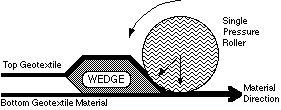
BPR — Base Pressure Roller
The pressure roller works against a supporting base or surface beneath the material. That arrangement can be packaged as a genuinely handheld wedge welder or engineered into an integrated system.
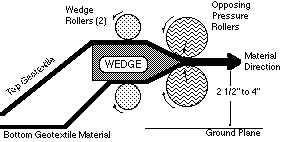
OPR — Opposing Pressure Roller
The heated overlap passes between opposing pressure rollers. This is the conventional arrangement used by many powered traveling wedge welders.
| Specifier Consideration | BPR | OPR |
|---|---|---|
| Pressure reaction | Pressure is applied against the supporting base or surface beneath the material. | Pressure is applied between opposing rollers. |
| Material path | The material can remain supported while the welder or integrated system moves along the seam. | The overlap must enter and pass through the opposing-roller path. |
| Machine form | Can be genuinely handheld, wheel-mounted, or built into an application-specific integrated system. | Typically configured as a powered traveling machine with an opposing-roller feed path. |
| Moving parts | Few moving parts in the original GT BPR field architecture. | More moving parts are required for the powered opposing-roller feed and travel mechanism. |
| Jamming / downtime | No opposing-roller feed path to jam. The original GT BPR field design eliminated downtime for clearing feed jams. | The overlap must feed through opposing rollers; a jam or misfeed requires the machine to stop while the material is cleared and repositioned. |
| Handheld use | The GT-100 is a purpose-built complete handheld BPR wedge welder with no powered drive system required for welding motion. | The opposing-roller arrangement normally depends on a powered or mechanically driven traveling mechanism. |
| Material overlap | In the original nonwoven geotextile field comparison, BPR used approximately a 2-inch overlap. | The comparable OPR field arrangement required approximately 6–8 inches of overlap. |
| Seam preparation | The original BPR nonwoven field process required no trimming preparation before welding. | The comparable OPR process required overlap preparation and trimming. |
| Field speed — nonwoven geotextiles | Historical GT-200 field performance reached up to approximately 50 feet per minute in suitable nonwoven applications. | The original Novaweld comparison listed conventional OPR field welding at approximately 5–10 feet per minute. |
| T-joints / layered intersections | BPR can be configured to cross existing welded seams and produce T-joints and selected multilayer intersections because pressure reacts against the supporting surface. | The opposing-roller gap can restrict T-joints and other layered intersections because the full assembly must pass through the roller nip. |
| Best fit | Applications where support, access, handheld operation, specialized seam geometry, reduced mechanical complexity, or application-specific integration favor a base-pressure arrangement. | Accessible overlapping seams where the material can be guided consistently through opposing rollers and continuous travel is the simplest solution. |
| Selection principle | Choose the architecture around the application—not simply around the machine. Material, seam geometry, access, support, workflow, production speed, and required performance should drive the decision. | |
Different Architectures for Different Work
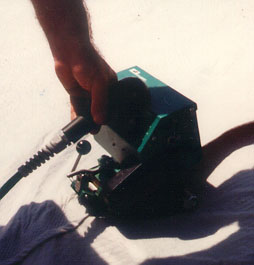
Historical Novaweld images show why the pressure arrangement matters. BPR can operate against supported material in several machine forms; OPR requires the seam to travel through the opposing roller geometry.
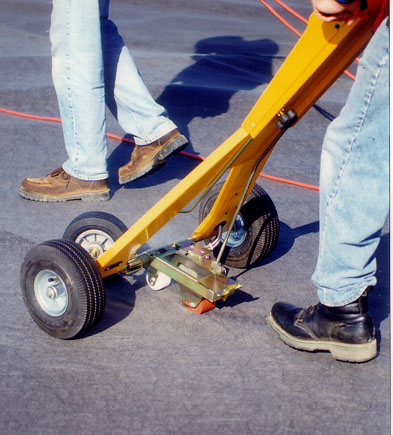
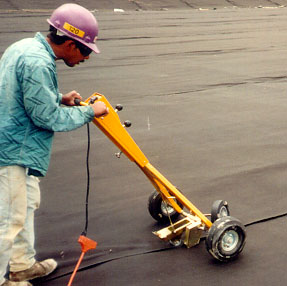
Handheld, Integrated, or Conventional?
GT-100 — Genuinely Handheld
Use the GT-100 when direct operator control, portability, access, repair work, field work, or flexible deployment makes a purpose-built handheld BPR system the simplest answer.
The GT-100 can also weld dissimilar flexible materials together when both materials can be heat welded.
Current GT-100 InformationGT-200 — Integrated BPR
Use the GT-200 when compatible nonwoven textile applications benefit from equipment engineered around material handling, workflow, T-joints, multilayer intersections, and specialized seam requirements.
Current GT-200 InformationOther Integrated GT Systems
Other application-specific BPR systems can be engineered for HDPE geomembranes, vinyls, heavier heat-weldable plastics, specialized material handling, seam tracking, controls, and tooling.
Discuss an ApplicationDo Not Specify the Welder from a Market Label Alone
Wedge welding is not limited to “geo” applications. Current GT work includes compatible nonwoven textiles, heavy vinyls, industrial fabrics, HDPE geomembranes, other heavier heat-weldable plastics, repairs, patches, straps, reinforcements, and compatible dissimilar materials.
Actual production suitability depends on the complete material composition and layer structure, seam design, process settings, support, and required performance.
ASTM D4884-96
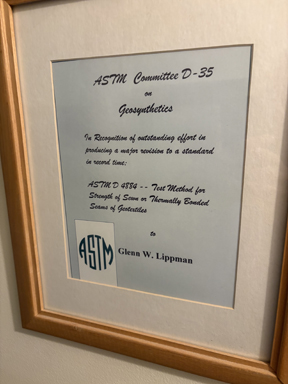
Glenn Lippman chaired the ASTM subcommittee responsible for the D4884-96 revision and led the major revision work. ASTM Committee D-35 on Geosynthetics recognized him for his outstanding effort in producing the revision.
ASTM D4884-96: Standard Test Method for Strength of Sewn or Thermally Bonded Seams of Geotextiles.
The practical objective was to evaluate seam performance by measurable results rather than by the joining method used.
The practical decision is whether BPR or OPR—and which machine configuration—best matches the material, seam geometry, access, support, workflow, production requirements, and required seam performance.
Start With the Application.
For current GT equipment, application engineering, quotations, service, or support, go to Novaseal.com. For broader technical information about wedge welding, BPR, OPR, materials, and process selection, continue at WedgeWelding.com.